
- Saturday , October 17, 2026
- Email Us: schoolofoccultscience@gmail.com
- +91 8920263942
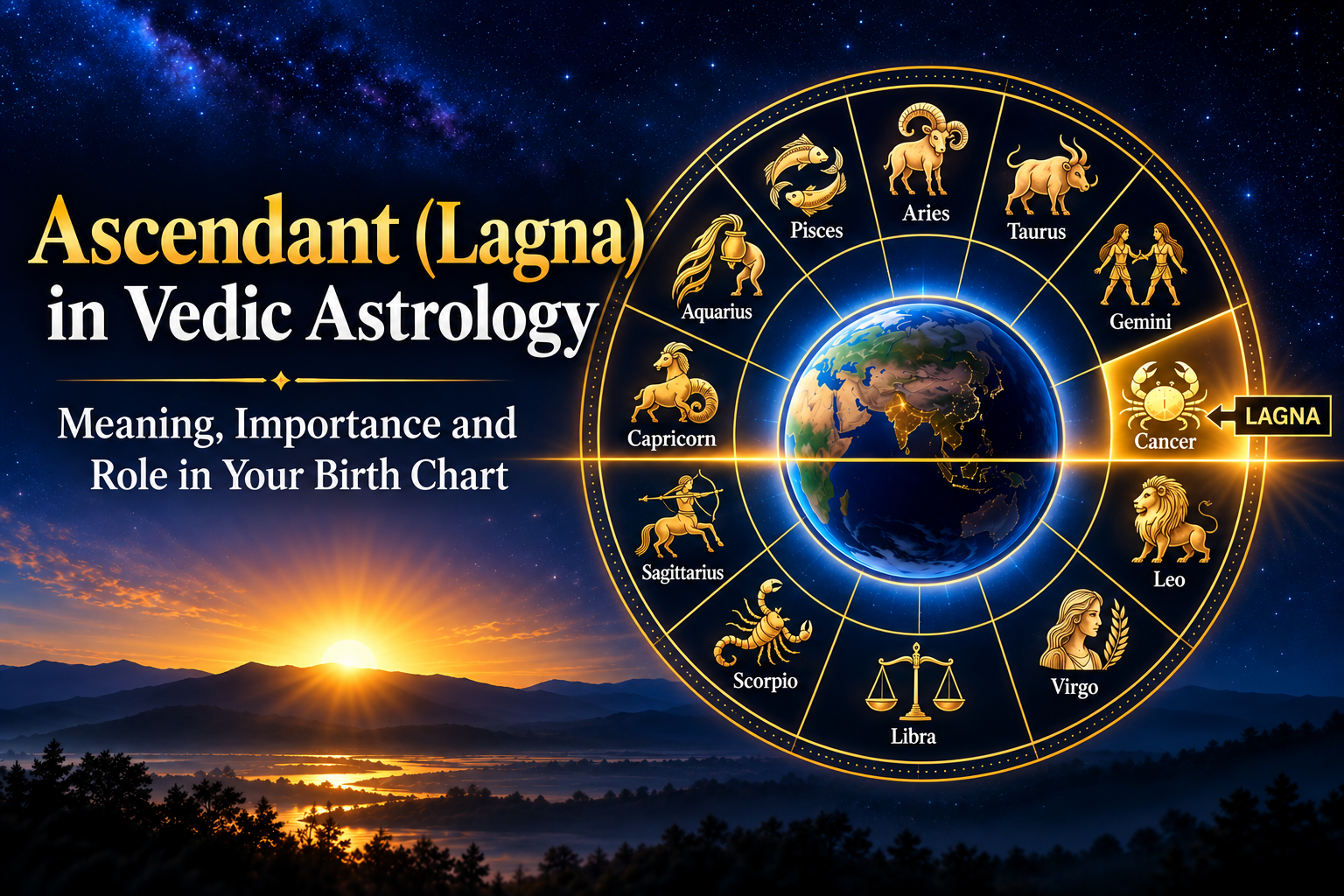
The Ascendant, or Lagna, is the zodiac sign rising on the eastern horizon at the time and place of birth.
What does it mean for a sign to rise? As
the Earth rotates from west to east, the sky appears to move in the opposite
direction. Different portions of the zodiac therefore appear above the eastern
horizon in succession, travel across the sky and eventually set in the west.
The sign containing the point of the zodiac rising on the local eastern horizon
at birth is the person's Lagna.
For example, if Cancer is rising at the time of birth, the person has Cancer Lagna; if Libra is rising, the person has Libra Lagna. Lagna depends on the exact birth time and location, not the date alone. More precisely, the Ascendant is a degree of the zodiac; the sign containing that degree determines the Lagna sign.
Watch: Understanding Lagna in Vedic Astrology
Watch this short video to understand the meaning of Lagna and why it is an important starting point for interpreting your birth chart.
The twelve zodiac signs pass across the eastern horizon over approximately one day. Dividing 24 hours by twelve gives an average of two hours per sign, but this is only an approximation. The time each sign takes to rise varies with geographical latitude: some signs rise for longer than two hours, while others rise for less. Longitude also matters when calculating the Ascendant at a particular clock time because it affects local sidereal time. An accurate calculation therefore requires the birth date, exact time, latitude and longitude.

A Vedic birth chart, or Janma Kundali, is
organised into twelve houses, traditionally called Bhavas. In the standard
Rashi chart used in Parashari astrology, the sign containing the Ascendant
becomes the first house. The remaining signs are counted in zodiacal order to
establish the other eleven houses.
For example, with Cancer Lagna, Cancer is
the first house, Leo the second, Virgo the third, and so on. The table below
shows the sequence for this example; it is not a list of the houses' full
significations.
|
House counted from Cancer Lagna |
Sign |
Traditional house name |
|
1st |
Cancer |
Tanu Bhava |
|
2nd |
Leo |
Dhana Bhava |
|
3rd |
Virgo |
Sahaja Bhava |
|
4th |
Libra |
Sukha Bhava |
|
5th |
Scorpio |
Putra Bhava |
|
6th |
Sagittarius |
Ari Bhava |
|
7th |
Capricorn |
Yuvati Bhava |
|
8th |
Aquarius |
Randhra Bhava |
|
9th |
Pisces |
Dharma Bhava |
|
10th |
Aries |
Karma Bhava |
|
11th |
Taurus |
Labha Bhava |
|
12th |
Gemini |
Vyaya Bhava |
Once this framework is established, we can
examine the planets occupying each house. A planet's zodiac sign and degree
describe its position in the zodiac, while Lagna provides the reference point
for identifying its house placement in the standard Rashi chart.
The sign sequence stays the same, but the
house assigned to each sign changes with Lagna. Cancer is the first house for
Cancer Lagna, but the tenth house for Libra Lagna. Aries is the tenth house for
Cancer Lagna, but the seventh house for Libra Lagna. This is why the Ascendant
affects both planetary house placement and house lordship.
|
Cancer Lagna |
Same sign |
Libra Lagna |
|
Cancer = 1st
house |
Cancer |
Libra = 1st
house |
This simple comparison shows why people
with similar planetary sign placements may still require different
interpretations when their Lagnas differ.
The planet ruling the sign of the Ascendant
is called the Lagna lord or Lagnesha.
|
Lagna |
Lagna lord |
Lagna |
Lagna lord |
|
Aries |
Mars |
Libra |
Venus |
|
Taurus |
Venus |
Scorpio |
Mars |
|
Gemini |
Mercury |
Sagittarius |
Jupiter |
|
Cancer |
Moon |
Capricorn |
Saturn |
|
Leo |
Sun |
Aquarius |
Saturn |
|
Virgo |
Mercury |
Pisces |
Jupiter |
In Vedic astrology, each house represents
particular areas of life, and its lord is an important factor in judging those matters.
The first house is associated with the native's body, physical constitution,
personality, general disposition and vitality. The Lagna lord therefore plays a
significant role in assessing these matters, alongside the condition of the
first house and other relevant factors.
An astrologer examines the Lagna lord's
sign and house placement, strength, conjunctions, aspects and relationships
with other planets. Its placement also connects the first house with the house
occupied by the lord. For example, if Cancer Lagna has the Moon in the tenth
house, the astrologer considers the relationship between the first and tenth
houses, while assessing the Moon's condition and other influences. This
connection is relevant to interpretation but does not, by itself, guarantee a
particular professional outcome.
The Lagna lord should not be judged in
isolation. Its significance is understood in relation to the Ascendant, the
first house and the wider horoscope.
Vedic astrology distinguishes natural
benefics (naisargika shubha grahas) from natural malefics (naisargika papa
grahas). A planet's functional role in a particular chart depends largely on
the houses it owns, and house ownership is determined by the Ascendant.
Natural benefics generally include Jupiter,
Venus, Mercury when not afflicted by natural malefics, and a sufficiently
bright Moon. The Moon's natural classification is connected with its phase and
brightness; it should not be treated as switching categories automatically at a
single universal day after Purnima. Natural beneficence is distinct from
functional beneficence: a natural benefic may own houses associated with
difficulties, while a natural malefic may own auspicious houses.
The sixth, eighth and twelfth houses are
commonly called the Trik houses. Their ownership can influence a planet's
functional role, but house ownership should not be used as the only criterion.
Likewise, natural malefics such as Saturn, Mars and the Sun may take on a
favourable functional role through ownership of auspicious houses. A planet
owning both a Kendra (1st, 4th, 7th or 10th) and a Trikona (1st, 5th or 9th)
may become a Yogakaraka under the applicable conditions.
In the standard Parashari scheme, Rahu and
Ketu do not own zodiac signs. Their effects are assessed through factors such
as placement, associations and the lords of the signs they occupy. The key
point is that the same planet can have different functional responsibilities
for different Lagnas. Its natural nature, house ownership, strength, placement
and associations must be considered together.
Yes. Two people with the same Lagna share
the same basic house arrangement and house lordships, but their planetary
placements may differ. For example, in two charts with Leo Lagna, the Sun is
the Lagna lord in both, yet it may occupy different signs and houses and
receive different aspects or conjunctions. The planets occupying other houses, the
condition of their lords and the operating Mahadasha and Antardasha periods may
also differ.
Knowing the Lagna alone is therefore not enough to interpret a complete horoscope. Lagna provides the foundation, while planetary placements, strength, house lordships and relevant Dasha periods must be considered together.